How to Select a Commercial Door
Start with the function of the opening rather than its appearance. A main public entrance may need to support high daily footfall, inclusive access and controlled opening. A back-of-house door may prioritise security and durability. A warehouse opening needs a system designed around vehicle movements, opening frequency and environmental separation. Fire-resisting or escape doors must also align with the building's fire strategy and the complete tested doorset specification.
The surrounding construction matters too. Door leaves, frames, thresholds, operators, ironmongery, access-control equipment, glazing, seals and adjacent curtain walling must work together. A technically suitable door can still perform poorly if the opening is measured incorrectly, drainage is obstructed, perimeter interfaces are weak or the operating hardware is unsuitable for actual traffic levels.
Pedestrian Entrance Doors
1. Aluminium-framed glazed doors
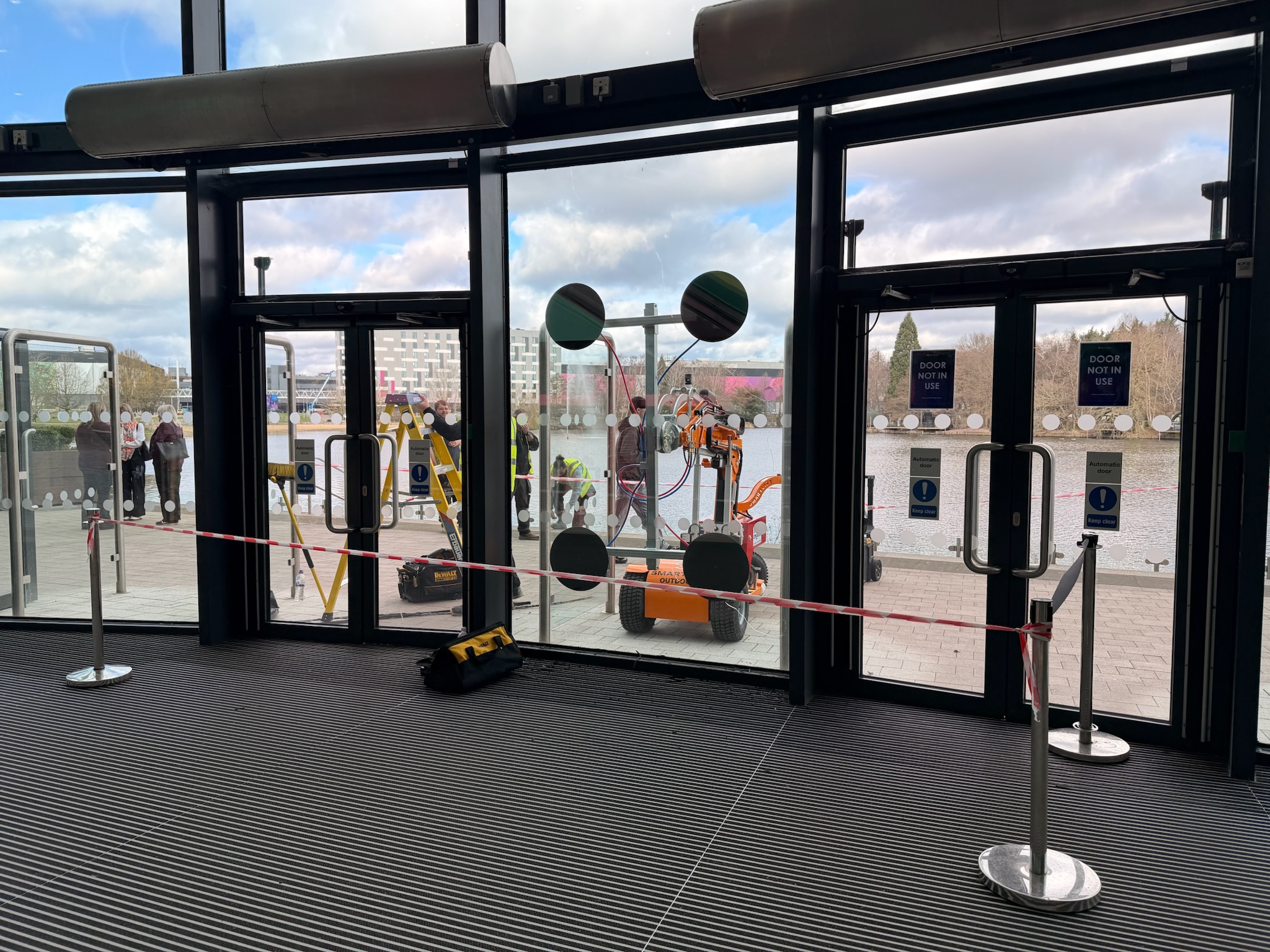
Aluminium-framed glazed doors are widely used at offices, shops, leisure venues and other commercial entrances because they combine a durable frame with good visibility and can coordinate with shopfront or curtain-wall systems. They may be configured as single or double leaves and fitted with manual, automatic or access-controlled hardware. Glass, manifestation, threshold and ironmongery requirements should be considered as part of the complete entrance rather than selected independently.
2. Manual swing doors
A conventional hinged swing door remains a practical choice for many internal and lower-frequency external openings. It is relatively straightforward to operate and maintain, but leaf width, opening force, closer control, threshold design and manoeuvring space all affect accessibility. In windy or exposed positions, the closer and restraining hardware need to be selected for the real conditions at the elevation.
3. Automatic swing doors
Automatic swing operators can improve access where a hinged door arrangement must be retained. They are often used in healthcare, offices, residential common areas and public buildings. The design needs adequate detection and safety devices, suitable approach space and a planned inspection regime. Existing doors should be assessed before retrofitting an operator because hinges, frame fixings and leaf condition must be capable of supporting repeated powered cycles.
4. Automatic sliding doors
Automatic sliding doors manage high pedestrian flow without requiring swing space, making them common at supermarkets, hospitals, hotels and transport environments. Single-slide, bi-parting and telescopic arrangements are available. Clear opening width, side-screen protection, activation zones, emergency breakout requirements and ongoing sensor checks are central to a safe, reliable installation.
5. Revolving doors
Revolving doors can reduce uncontrolled air exchange at busy entrances and help manage continuous traffic in larger commercial buildings. They require careful coordination with accessible alternative routes, emergency egress and the entrance lobby. Their size and moving components also make specialist servicing essential; they should not be treated as ordinary hinged-door hardware.
Safety and Security Doors
6. Steel security doors
Steel doorsets are commonly used for plant rooms, service corridors, stock areas and external openings where robustness and resistance to forced entry are priorities. The security performance depends on the complete assembly, including the frame, leaf construction, locks, hinges, fixings and surrounding wall. Adding a strong lock to a weak frame does not create a properly specified security doorset.
7. Fire-resisting doorsets
A fire-resisting doorset is a coordinated life-safety assembly, not simply a door leaf with a label. The leaf, frame, seals, glazing, hinges, closer, latch and installation details must match the supporting test evidence and the building's fire strategy. Alterations, replacement glazing and hardware substitutions can affect performance, so inspection and remedial work should be undertaken by competent specialists using compatible components.
8. Emergency-exit and panic-exit doors
Escape-route doors are selected around occupancy, expected user familiarity and the approved fire strategy. Panic hardware may be needed where members of the public could have to operate an exit under pressure, while other controlled escape doors use different emergency-release arrangements. Access control must not prevent safe escape. Final hardware and signage requirements should be confirmed by the responsible fire and building professionals for the premises.
Industrial and Service-Yard Doors
9. Roller shutters
Roller shutters use interlocking slats that coil above an opening, conserving floor and wall space. They are used on loading areas, kiosks, counters and secure service openings. Wind exposure, opening dimensions, operating frequency, motor duty, safety edges and emergency operation all affect the appropriate system. A shutter should not be assumed to provide fire resistance unless it is a specifically tested and correctly controlled fire-shutter assembly.
10. Sectional overhead doors
Sectional doors travel vertically and then along tracks beneath the roof, making them a common choice for warehouses, workshops and vehicle bays. Insulated panels can support environmental control, while viewing sections provide visibility. Tracks, springs, cables, panels and safety devices are all service items, so the available headroom and future maintenance access should be allowed for at design stage.
11. High-speed doors
High-speed fabric or rapid-roll doors are designed for frequent opening cycles where temperature, cleanliness or traffic separation matters. They are often installed between internal zones or behind an external security door. Activation method, approach speed, impact recovery, safety detection and the duty cycle need to reflect actual forklift, vehicle and pedestrian movements.
12. Loading-bay and vehicle-access doors
Loading-bay openings may combine an overhead door with dock levellers, shelters, restraints, traffic controls and protective barriers. Larger vehicle entrances can also use folding, sliding or specialist hangar-style systems. These are operational systems with multiple interfaces, so the door cannot be specified separately from bay geometry, vehicle types, edge protection and safe working procedures.
Key Commercial Door Specification Checks
Once the broad door type is known, record how the opening will be used. Useful information includes peak pedestrian or vehicle flow, opening cycles, required clear width, exposure, access-control strategy, emergency operation, glazing needs, available headroom and the consequences of downtime. Survey the structure and interfaces, not only the nominal opening size.
- Accessibility: approach space, clear opening, threshold, opening force and controls.
- Safety: risk around moving leaves, glass, finger traps, sensors and vehicle interfaces.
- Security: doorset classification, locking, access control and surrounding construction.
- Fire and escape: the approved strategy, certification and compatible ironmongery.
- Weather and energy: seals, drainage, air leakage, thermal bridging and entrance-lobby design.
- Maintainability: access to operators, tracks, closers, controls and replaceable components.
Inspection and Maintenance
Commercial doors are frequently used moving assets. Inspection frequency should reflect risk, traffic and manufacturer guidance rather than relying on a single interval for every opening. Problems such as scraping, slamming, delayed closing, damaged seals, loose fixings, unreliable sensors or repeated access-control faults should be investigated before they become a safety or security failure.
Keep a simple asset register that identifies each door, its type, critical components, service history and outstanding defects. Fire-resisting, powered and escape doors need inspection appropriate to their function and the building's compliance arrangements. Where glazing or the surrounding aluminium system is damaged, coordinate the door contractor and glazing specialist so one repair does not compromise the other system.
Who Should Handle the Work?
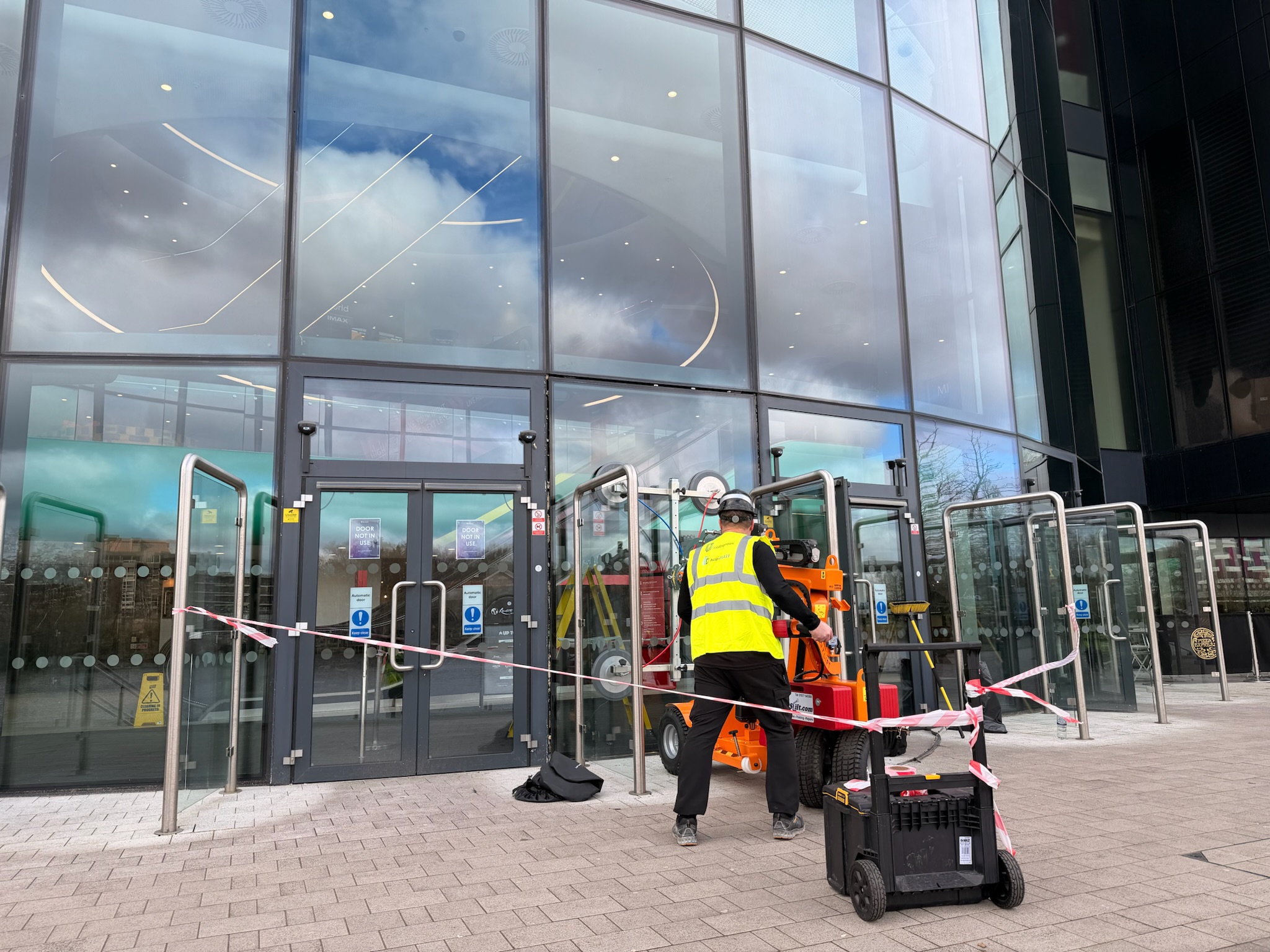
Alu-Glaze specialises in commercial glazing, aluminium windows, curtain walling and replacement glass in existing shopfront systems. Complete commercial entrance-door systems, automatic doors, industrial doors and door maintenance are handled by our specialist sister company, Door Engineers. This distinction ensures door enquiries reach engineers equipped for the complete doorset and its controls.
If the issue is confined to cracked or failed glass within an existing serviceable shopfront frame, see Alu-Glaze's shopfront glass replacement service. For façade glazing or curtain-wall interfaces around an entrance, review our curtain walling and commercial glazing repair services.
Frequently Asked Questions
Which door is best for a busy public entrance?
Automatic sliding or revolving systems often support high traffic, but the correct choice depends on
accessible routes, available space, emergency operation, exposure and the building's entrance strategy.
Can an existing manual door be automated?
Sometimes. The existing leaf, hinges, frame, fixings and clearances must be assessed before an operator is
added, and the completed powered door needs the appropriate safety devices and commissioning.
Is every steel door a security or fire door?
No. Material alone does not establish tested security or fire performance. The classification applies to a
complete doorset installed in accordance with its evidence and specification.
Who repairs the glass in an existing shopfront?
Alu-Glaze can replace damaged or failed glass in an existing serviceable shopfront frame. Repairs to the
entrance-door leaf, operator, access control or complete doorset should go to Door Engineers.